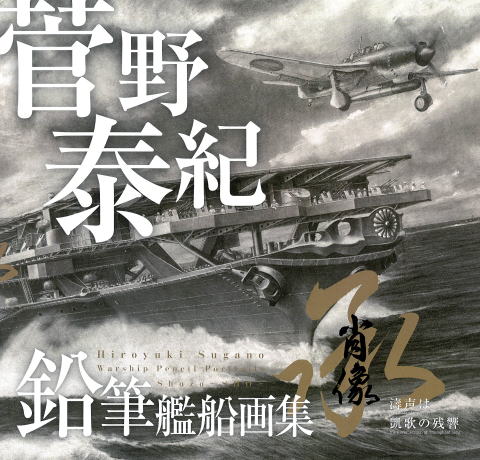
「海征く牙狼 -重巡洋艦 羽黒 2602-」
“Conquering Wolf of thr Sea -Heavy cruiser HIJMS Haguro 2602-”
重巡洋艦「羽黒」は、妙高型重巡洋艦の4番艦です。大正14(1925)年3月16日に三菱造船長崎造船所で起工。昭和3(1928)年3月24日に進水、昭和4(1929)年4月25日に竣工しました。就役後には第二艦隊第四戦隊を編入されました。
大東亜戦争では、開戦時には第三艦隊第五戦隊に所属し、フィリピン攻略・南方作戦・蘭印作戦に参加。翌年のジャワ攻略作戦中のスラバヤ沖海戦ではアメリカ、イギリス、オランダ、オーストラリア連合艦隊とと交戦。この戦いが大東亜戦争における事実上初めての水上部隊同士の海戦となりました。その後も珊瑚海海戦・第二次ソロモン海戦・マリアナ沖海戦・レイテ沖海戦に参戦。昭和20(1945)年6月15日夜にマレー半島北西岸、マラッカ海峡内に位置するペナン島沖で起きたイギリス海軍との間でペナン海戦(夜戦)が勃発。イギリス駆逐艦による雷撃で、羽黒は損傷。戦場に留まり、随伴する神風を離脱させた。最終的に3本の魚雷が命中し、羽黒は艦首部分から沈没しました。羽黒に座乗していた橋本信太郎中将、艦長杉浦嘉十少将、機関長堺谷友太郎大佐以下400名あまりが戦死し、320名が引き返してきた神風に救助されました。
作品は、昭和17(1942)年のスラバヤ沖海戦後の「羽黒」を描きました。写真資料の中でとりわけ作者の目を引いたものが、スラバヤ沖海戦後に甲板上で撮影された「羽黒」の前部主砲と艦橋の写真でした。写真では2時間で約60斉射という激しい砲撃による熱と衝撃で、主砲身のペンキが剥げ落ちまだらになっている様子が確認できます。きわめて印象的でしたので、ペンキが焼け落ちまだらになった主砲身を表現してみました。作品上では1cm程度なのですが…。
【画集第2弾 好評発売中!】
菅野泰紀鉛筆艦船画集
「肖像 -承- 濤声は凱歌の残響」
Hiroyuki Sugano Warship Pencil Portraits
“Shozo - SHO - The Roar of the Waves,
the Reverberation of Triumphant Song”
総頁数:156P 販売価格:4,400(税込*)*BOOTH価格は梱包・送料込
収録作品:79点(帝国海軍艦艇/海自艦艇/外国海軍艦艇)
仕様:見開きにズレが無く、ほぼ水平に開くク―タ・バインディング製本
Total number of pages: 156p
Price: 4,400(tax included*)*BOOTH price includes packing and shipping costs.
Included works: 79 pieces (IJN, JMSDF, US, British, French, German
and Italian Navy vessels)
Specifications: PUR binding with no misalignment of spreads and horizontal
opening.
The heavy cruiser Haguro is the fourth ship of the Myoko class heavy cruisers.
The construction was started on March 16, 1925 at the Nagasaki Shipyard
and Machinery Works of Mitsubishi Shipbuilding Corporation. She was launched
on March 24, 1928 and completed on April 25, 1929. After her commissioning,
she was assigned to the 4th Division of the 2nd Fleet.
In the Greater East Asian War, IHaguro belonged to the 5th Division of
the 3rd Fleet at the beginning of the war, and participated in the Philippines
campaign, the Southern Operation, and the Dutch East Indies campaign. In
the Battle of the Java Sea during the Java campaign the following year,
she engaged the United States, British, Dutch, and Australian combined
fleets. This battle was in fact the first naval battle between fleets in
the Greater East Asian War. She continued to participate in the Battle
of the Coral Sea, the Battle of the Eastern Solomons, the Battle of the
Philippine Sea, and the Battle of Leyte Gulf. On the night of June 15,
1945, the Battle of the Malacca Strait (night battle) broke out with the
Royal Navy, which took place off Penang Island, located in the Malacca
Strait, on the northwest coast of the Malay Peninsula. Haguro was damaged
by multiple torpedo attacks by British destroyers. However, she continued
to remain in the combat zone and broke away from the accompanying kamikaze.
Finally, three torpedoes hit the Haguro and she sank from the bow section.
Rear Admiral Shintaro Hashimoto, Rear Admiral Kaju Sugiura, Colonel Tomotaro
Sakaiya, chief engineer, and about 400 others who were seated aboard Haguro
were killed in action, and 320 were rescued by the kamikaze which turned
back.
This work depicts the Haguro after the Battle of the Java Sea in 1942.Among
the photographic materials, one in particular caught my attention: a photograph
of the Haguro's forward main guns and bridge, taken on deck after the Battle
of Java Sea. In these photos, the paint on the main gun barrel is peeling
off and the surface is mottled due to the heat and impact from the intense
bombardment of approximately 60 rounds in two hours. It was very impressive,
so I tried to represent a group of main gun barrels whose paint had burned
off and turned into a mottled mess. The size of the barrels is only about
1 cm.